
11/28/2025
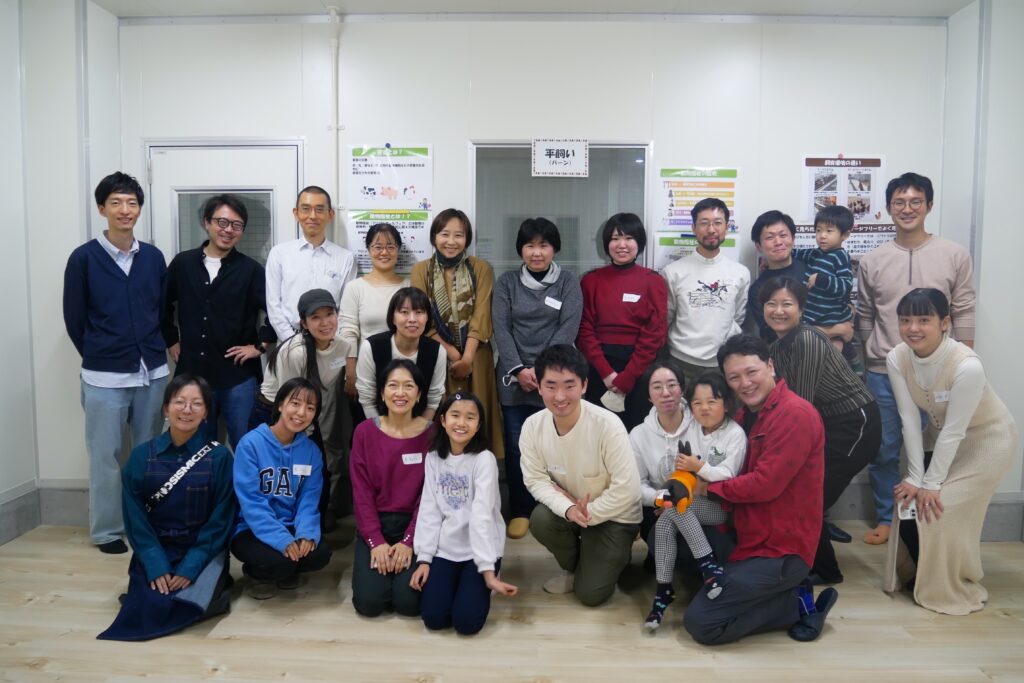
Building on our first joint event, Lively LLC co-hosted its second collaborative event with IDEAS FOR GOOD on Saturday, November 15, 2025. IDEAS FOR GOOD is an online media platform operated by Harch Inc. that introduces creative ideas and solutions from around the world. The event was held in collaboration with Professor Tsuyoshi Shimmura of the Graduate School of Agriculture at Tokyo University of Agriculture and Technology (TUAT). The event was held in collaboration with Professor Tsuyoshi Shimmura of the Graduate School of Agriculture at TUAT. The program took place at Unshelled, an animal welfare model facility, and offered an experiential education program on animal welfare.
A total of 16 participants, including 13 adults involved in sustainability and agriculture and 3 children interested in animal welfare, attended the event. Participants engaged in a mini-workshop on the scientific evaluation of animal welfare, toured a circular insect farm, and compared the taste of cage-free and caged eggs.
Participants shared comments such as, “I usually don’t get to touch hens, so this was a rare and valuable experience,” and “I could really feel the difference between cage-free and caged eggs, and I learned about using insects as feed.” As the second joint event with IDEAS FOR GOOD, overall satisfaction remained high. Please also see the full event report by IDEAS FOR GOOD here.
This event was held as the second collaborative program with IDEAS FOR GOOD. From the perspective of promoting the social implementation and education of animal welfare together with Professor Tsuyoshi Shimmura, Lively led the initiative as a co-host, overseeing activities ranging from program planning to on-site operations on the day of the event.
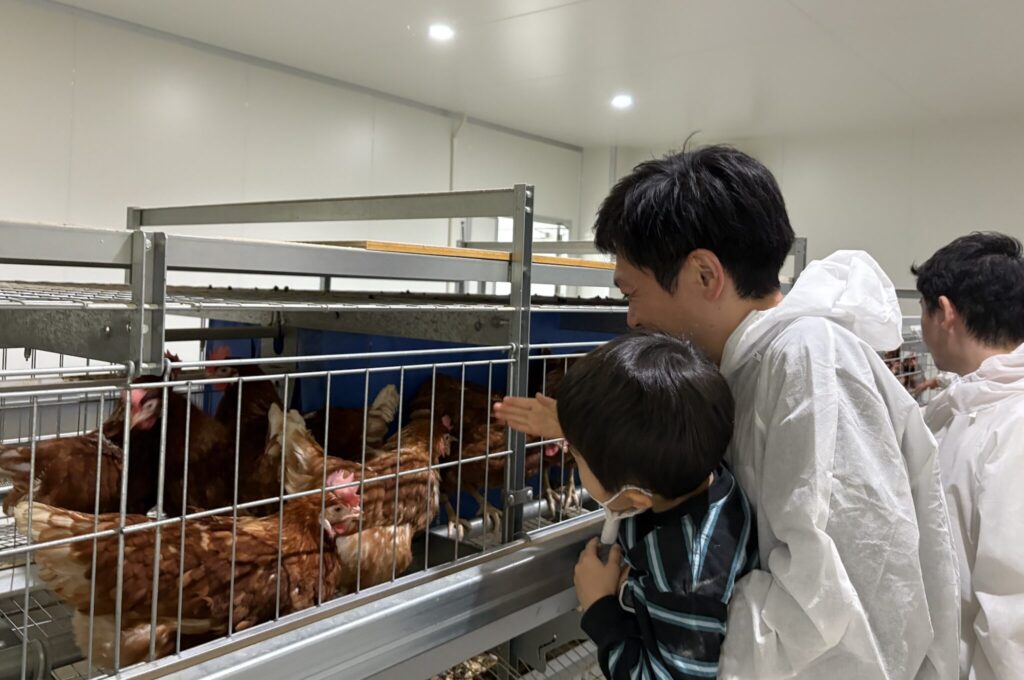
Within Unshelled are four dedicated housing areas representing different systems for egg-laying hens—conventional cages, enriched cages, multi-tier aviaries, and free-range/barn systems. These housing areas are normally viewed through windows from a central observation room. During this event, however, participants were given special access to enter the housing areas themselves, offering a rare opportunity to observe hens up close and experience their behavior and emotions firsthand.
In Japan, feed for egg-laying hens relies heavily on imports, which has raised concerns about transportation-related greenhouse gas (GHG) emissions, as well as environmental impact and business sustainability amid rising costs. Given this situation, the event also introduced insects as a potential alternative feed option and shared examples of circular production. Participants also visited an insect research facility based on the concept of a “natural energy–powered insect factory,” completed on February 29, 2024, at the Fuchu Campus of TUAT.
Reference: IDEAS FOR GOOD EVENT: Exploring the Future of Food for People and Animals through Embodied Knowledge × Science at Unshelled.
Reference: TUAT: Frontier Research Institute, Field-Based Deep Tech Research Hub
Event Name: Exploring the Future of Food for People and Animals through Embodied Knowledge × Science at Unshelled
Date & Time: Saturday, November 15, 2025, 17:30–19:30
Venue: Unshelled at the Fuchu Campus of TUAT (3-8-1 Harumi-cho, Fuchu, Tokyo)
Host Organizations: IDEAS FOR GOOD、Lively LLC
Facilitators: Motomi Soma (IDEAS FOR GOOD), Tomomi Miura (Lively LLC), Professor Tsuyoshi Shimmura (TUAT)
At the event, participants were given special access to enter the hen housing areas and observe hen behavior up close, allowing them to experience animal welfare assessment methods from a scientific perspective. Participants also toured an insect research facility that demonstrates the circular use of residues to produce insect-based feed, learning about the connection between animal welfare and the circular economy.
・Observing Hen Behavior: Animal Welfare Mini Workshop
Professor Tsuyoshi Shimmura and a member of his research group conducted an experiment to examine hens’ fear responses toward humans and cognitive bias, a phenomenon in which judgments are influenced by the surrounding environment. The same stimuli were applied to hens raised in cage systems and cage-free systems, allowing participants to compare and assess how differences in rearing environments influence animal behavior.
・Introduction to Insect-Based Feed and Circular Systems
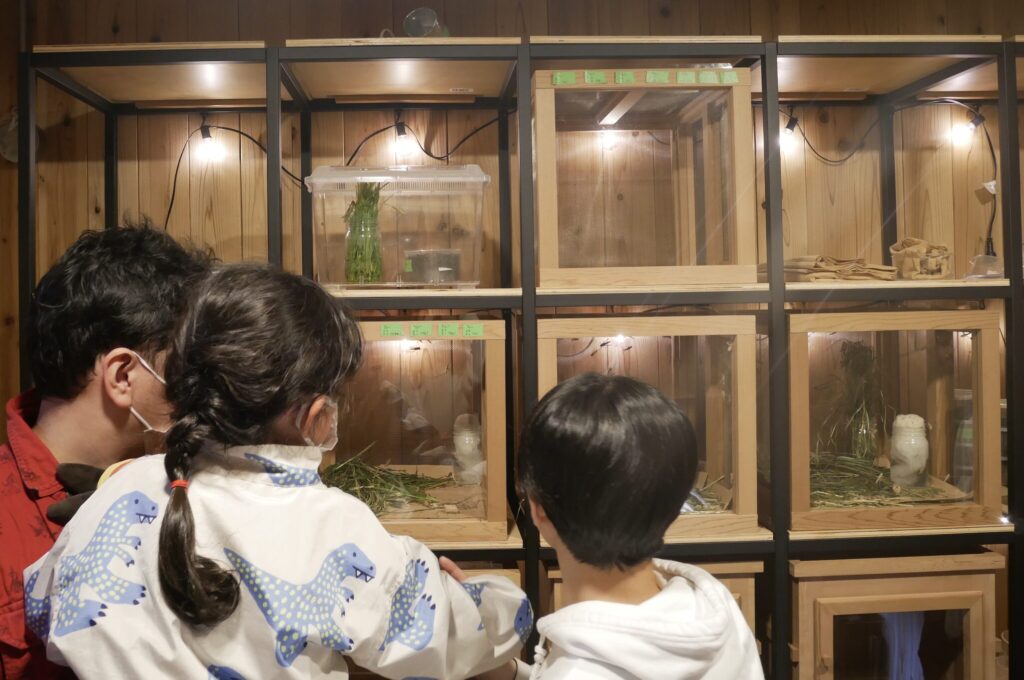
Professor Takeshi Suzuki and members of his research group from the Graduate School of Agriculture at TUAT guided participants on a tour of the insect research facility. The session introduced the research concept of a “natural energy–powered insect factory,” which utilizes powdered agricultural by-products and food processing residues to produce insects that can be used as feed for laying hens, contributing to a circular production system.
・Egg Tasting: Experiencing Differences Caused by Rearing Environments
Eggs produced under different rearing environments, including caged and cage-free conditions, were prepared and compared in a blind taste test. Participants experienced how differences in rearing environments can affect taste and nutritional characteristics.
Participants shared comments such as:
“Through dialogue and rich experiences, I was able to better understand how animal welfare connects to our own health and daily lives.”
“Experiencing the simple question of what eggs from insect-fed hens might taste like was truly valuable.”
“From observation and facility tours to tasting experiences and dialogue, the program enabled deep understanding through meaningful experiences rather than passive learning.”
The post-event survey results further reflected this positive response, with 80% of participants rating the event as ‘very satisfied’ and 20% as ‘satisfied,’ indicating a high level of overall satisfaction among all participants. In addition, one out of four adult participants attended the program for the second time, indicating repeat participation.

Thanks to the generous collaboration of IDEAS FOR GOOD, Professor Tsuyoshi Shimmura and Professor Takeshi Suzuki of TUAT, their research groups, and all participants who joined us, this two-part program was made possible. We are sincerely grateful to have co-created these programs together.
This second event placed a stronger focus on experiential learning than the first. Co-hosted with IDEAS FOR GOOD, the program was designed to allow participants to learn through direct experience. By entering different hen rearing environments and observing hens up close—while also physically interacting with them—participants were able to gain a more practical and scientific understanding of animal welfare.
As a new element of this collaboration, the program also introduced the connection between insects and circular systems. From the perspective of the future sustainability of egg production, it addressed challenges such as reliance on imported feed and environmental impacts, while presenting circular feed production using insects as an alternative feed option. The theme of hens and insects attracted strong interest from participants and led to new insights.
Lastly, the experiential animal welfare education programs at Unshelled officially launched in May 2025. Over the following eight months, a total of approximately 80 people participated in these programs. Please stay tuned for further updates on Lively’s official website.
We look forward to welcoming you again at Unshelled next year.